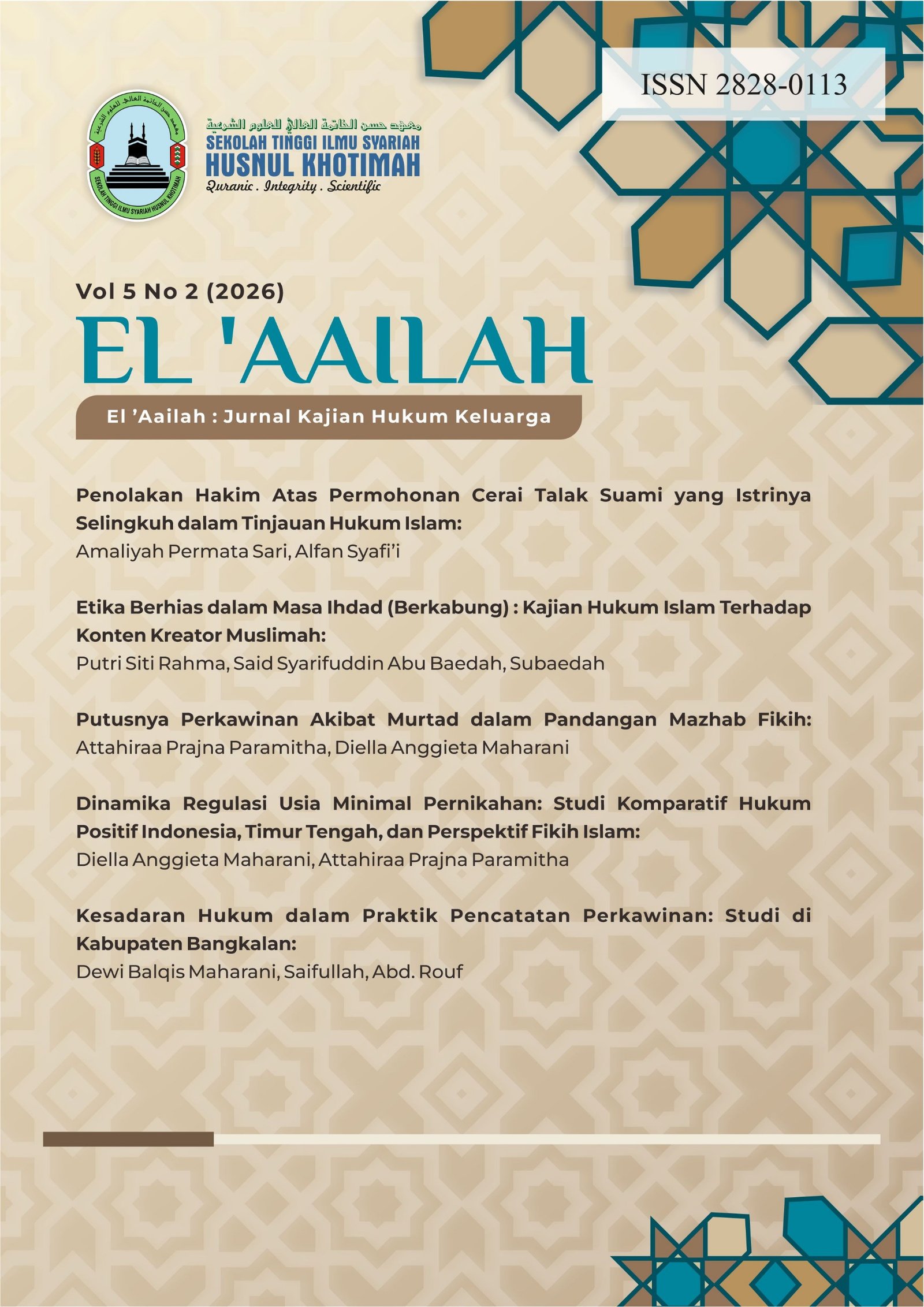
Dinamika Regulasi Usia Minimal Pernikahan
Studi Komparatif Hukum Positif Indonesia, Timur Tengah dan Perspektif Fikih Islam
DOI:
https://doi.org/10.59270/aailah.v5i2.389Keywords:
Age of Marriage, Positive Law, Middle East, FiqhAbstract
Determining the minimum age for marriage is a crucial issue in family law studies, with broad implications for the protection of children's rights, reproductive health, and the psychological readiness of couples to establish a family. Setting the minimum age for marriage is not merely a legal issue but also encompasses the social, cultural, and religious dimensions that exist within society. Therefore, the differences in marriage age settings across legal systems are interesting to examine comparatively. This article aims to analyze the comparative law on the age of marriage in Indonesian Positive Law, marriage laws in several Middle Eastern countries, and the perspective of Islamic Fikih. In Indonesia, the minimum age of marriage is regulated in Law Number 16 of 2019 concerning Amendments to Law Number 1 of 1974, which sets the minimum age limit for marriage at 19 years for both men and women. Meanwhile, Middle Eastern countries show variations in the age limit for marriage, depending on the interpretation of Islamic law and the policies of each country. Islamic Fikih, which is based on the Quran and Hadith, does not set a specific age, but recommends physical and mental maturity as the main requirements. This study finds that differences in marriage age regulations reflect the complexity of the interaction between religious law, social norms, and state policies.
Downloads
Published
Issue
Section
License
Copyright (c) 2026 El 'Aailah: Jurnal Kajian Hukum Keluarga

This work is licensed under a Creative Commons Attribution-NonCommercial-ShareAlike 4.0 International License.